
Why Pump Storage
Pump Storage
Pump Storage Sector
Between 2007 and 2015, the total installed capacity of renewables electricity in Scotland has more than doubled. Due to its intermittent nature, the rise in renewable generation has resulted in increased demand for flexible capacity to help meet energy balancing requirements for the national grid system.
Pumped storage hydro is considered by the Directors to be the most developed and largest capacity form of grid energy storage that currently exists. This can help reduce renewable energy curtailment and therefore promote grid stability.
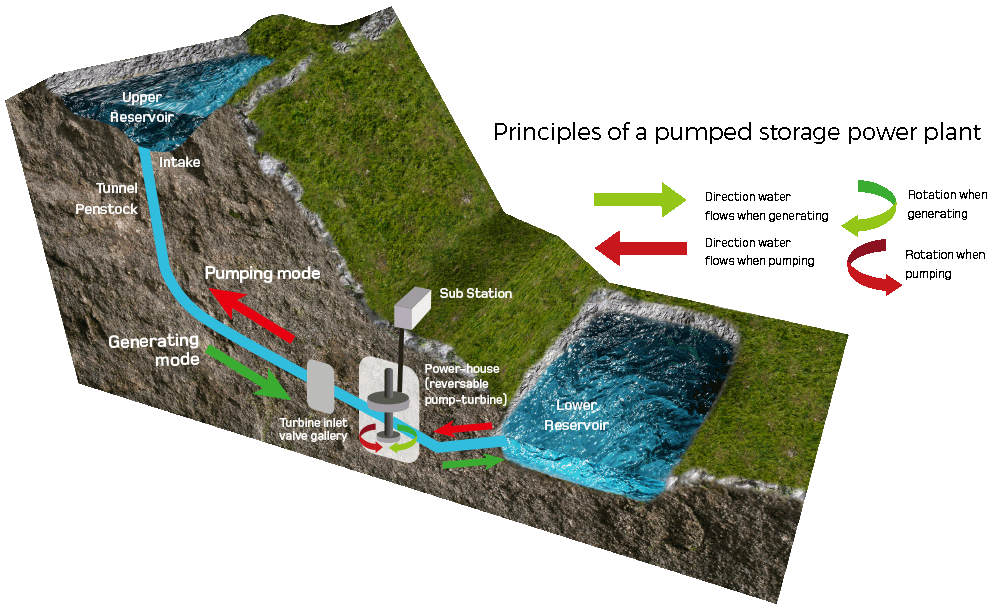
PSH Technology
Pumped storage is a way of storing energy by turning electrical energy into stored (or potential) energy and back again to electrical energy. The system uses electricity to pump water from a lower reservoir to a higher reservoir. This pumping happens at times when there is more energy being produced on the grid network than is needed. This energy is stored until it is required, when the water is allowed to flow back through a hydro-turbine, generating electricity to meet sudden or predicted spikes in consumer demand.
This cycle of pumping and generating repeats on a daily basis as required. Pumped storage utilises excess generated electricity when consumer demand is low and generates electricity when demand requires. It can be used at very short notice to provide what the Directors consider to be a flexible and valuable balancing service to the relevant distribution network operator.
A typical conventional pumped storage hydro power plant consists of four components:
- Water reservoirs: normally two interconnected water reservoirs.
- Water piping: tunnels that allow moving water from one reservoir to another.
- Powerhouse: facility with one or more pump/turbine and motor/generator assemblies that allow pumping water into the upper reservoir at off-peak hours, and discharging water into the lower reservoir.
- Grid connection: power transmission lines to move the generated power from the plant into the grid.
Components are often housed underground.
It is widely acknowledged that greater flexibility is required in the electricity system of Great Britain (GB) to decarbonise at acceptable cost to consumers. PSH is one of the best proven technologies available at scale to provide the required flexibility.
A new study in 2021 by independent researchers from Imperial College London has found that just 4.5GW of new long duration pumped hydro storage with 90GWh of storage could save up to £690m per year in energy system costs by 2050, as the UK transitions to a net-zero carbon emission system.
It can reduce system costs by providing a number of services to the GB net-zero emission energy system. These are:
- Reduced wind curtailment by storing excess renewable production and discharging it when needed.
- Provision of critical ancillary services needed for integrating a high penetration of renewable generation, particularly frequency response and operating reserves, while enhancing system inertia.
- Reducing system emissions by displacing operation of some conventional (fossil-fuel based) mid-merit and peaking plant.
- Supporting network congestion management and reducing the need for transmission network reinforcement between Scotland and England.
Benefits of
Pump Storage Hydro
- It is a clean energy resource
- It does not benefit from or require other subsidies
- It is a proven, reliable technology, available at large scale, with an asset life of 100+ years
- It can provide firm capacity for longer periods than batteries or demand response
- It can mitigate network constraint costs, and reduce the need for network investment
- It can provide the full range of balancing services, including black start, inertia, frequency response, reserve and reactive
- It helps solve the issue of intermittency in renewable energy generation
- It will help reduce consumer’s bills
- It will provide long-term energy security for the UK
- It will off-set millions of tonnes of CO2 emissions each year


